
Where Single Man Lifts Get the Job Done
Single man lifts show up anywhere a crew needs quick, controlled access to height without the footprint of a full-size aerial platform.
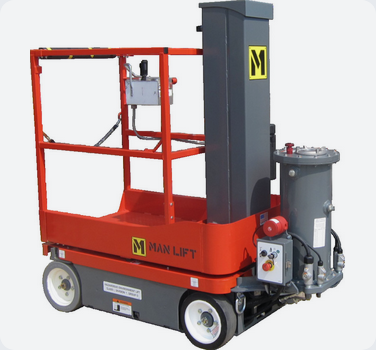
Common applications include:
- Warehouse and distribution centers — restocking high shelving, servicing conveyor systems, and reaching overhead lighting or HVAC units without shutting down aisles.
- Retail and facility maintenance — changing signage, cleaning skylights, and servicing fixtures in occupied spaces where a bulkier lift wouldn’t fit.
- Electrical and low-voltage work — accessing ceiling-mounted wiring, security cameras, and network drops in office buildings and data centers.
- Manufacturing plants — reaching machinery, ductwork, and overhead conveyors on production floors with tight aisle spacing.
- Event and venue setup — hanging lighting rigs, banners, and AV equipment in convention centers and auditoriums.
Because these machines are narrow enough to pass through a standard doorway and light enough for most indoor floor loads, they’re often the only aerial lift option available for interior jobs where a scissor lift or boom lift simply won’t clear the space.
Self-Propelled vs. Push-Around: Choosing the Right Type
The page above notes that single man lifts come in self-propelled and push-around configurations — here’s how to decide between them:
Self-propelled (drivable) models are built for operators who need to reposition frequently across a large floor plan. The operator can drive the unit from the platform, raise and lower height on demand, and cover more ground per shift without stepping down to relocate the machine manually. These are the better fit for large warehouses, distribution centers, and any job with repeated moves across a wide area.
Push-around models are the lighter, more budget-friendly option. Since they’re manually wheeled into position and then locked in place before raising, they suit jobs with occasional height changes in a smaller, more contained area — think retail backrooms, small offices, or maintenance calls that only require a handful of setups per visit. Their reduced weight also makes them easier to transport between job sites in a standard van or trailer.
Neither type sacrifices the core benefit of a vertical mast design: a small footprint, straight up-and-down travel, and platform capacity built for one worker and their tools.
Key Benefits of Vertical Mast Lifts
- Narrow footprint — most models fit through a standard 32-36 inch doorway, opening up job sites that boom lifts and larger scissor lifts can’t access.
- Non-marking tires — many units are equipped for use on finished floors, gym surfaces, and other delicate flooring without leaving marks.
- Zero tail swing — the vertical mast travels straight up rather than extending outward, which keeps the machine’s footprint predictable in tight aisles.
- Quiet, low-emission operation — electric-powered models are well suited to indoor use where noise and exhaust are a concern.
- Fast setup — with no outriggers or stabilizers to deploy on most models, operators can be at working height within minutes of arriving on site.
Choosing a Working Height and Capacity
Before renting or buying, it helps to match the lift to the job rather than defaulting to the tallest option available:
- Measure the actual reach needed, including the height of the task itself plus a few feet of comfortable working clearance — not just the ceiling height.
- Account for tools and materials the operator will carry onto the platform, since rated platform capacity includes the worker’s weight plus anything they bring up with them.
- Check aisle and doorway widths at the job site against the machine’s stowed width and turning radius, especially for self-propelled models.
- Confirm floor load limits for upper-floor or sensitive-surface applications, particularly with heavier self-propelled units.
Frequently Asked Questions
How high can a single man lift reach? Working heights vary significantly by model, typically ranging from around 12 feet up to 20+ feet of platform height, which translates to several additional feet of actual reach for the operator.
Do single man lifts require a certified operator? Yes. OSHA generally classifies vertical mast lifts as aerial work platforms, meaning operators should complete manufacturer-specific training before use, even though the controls are simpler than a boom lift.
Can single man lifts be used outdoors? Some models are rated for outdoor use on firm, level surfaces, but many are designed primarily for indoor applications. Always check the specific model’s ground surface and weather requirements first.
What’s the difference between a single man lift and a scissor lift? A single man lift uses a vertical mast and supports one worker, while a scissor lift uses a scissoring mechanism and typically supports a larger platform with multiple workers and greater capacity — at the cost of a larger footprint.
How much does a single man lift cost to rent or buy? Pricing depends on working height, drive type (self-propelled vs. push-around), and power source. Contact our team for current rental and purchase pricing on the models listed above.